
This new 9mm pistol is going after a portion of the law enforcement and military market share, and has been engineered by Taurus to meet the needs of professional, defensive, and concealed-carry users. While the parts come from Brazil, it’s being built in the USA, and is designed to meet military and law enforcement requirements worldwide, including NATO specifications. This is a fully modular platform, and offered in Full Size, Compact, and Subcompact configurations. Striker-fired, it has unified controls, T.O.R.O. slides for optics use, and a serialized chassis. The modular system allows end users to quickly swap between the full, compact, and subcompact frame sizes.
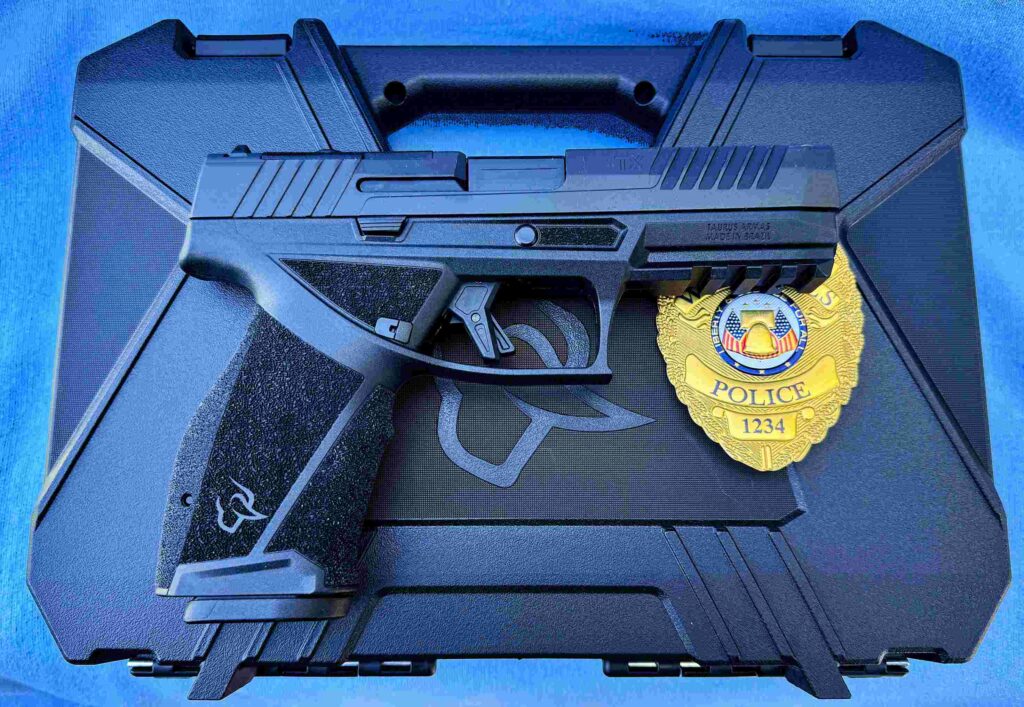
I elected to evaluate the Full Size, “Duty” version of the TX9 a handgun most likely to be found inside a duty holster. This full-size version has a 4.5-inch barrel, an overall length of 7.75 inches, a height of 5.2 inches, a width of 1.28 inches, and an empty weight of 25 oz. Its alloy steel slide has a black gas nitride finish, while the alloy steel barrel is matte black, with a 1:16.5 in RH twist. In the breech-end of the barrel is a small port that serves as a loaded chamber indicator. It’s comes with Glock-pattern sights; a white dot front and dovetail rear sight that can be moved laterally for windage adjustment. Both the front and rear of the slide are serrated, and there’s an external extractor.
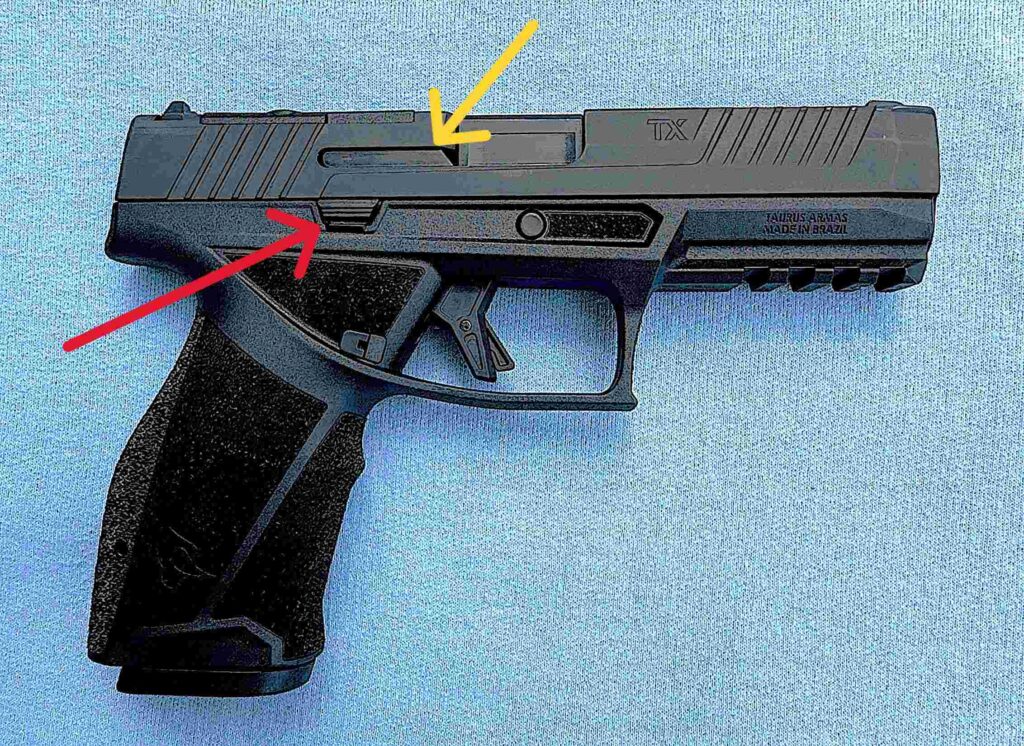
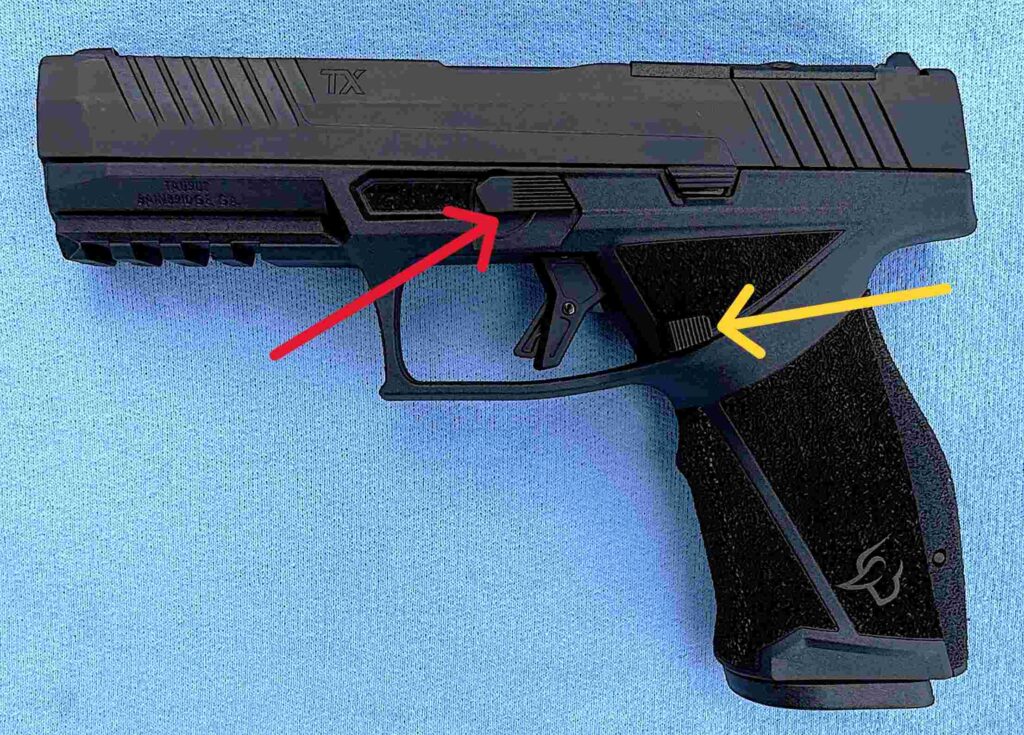
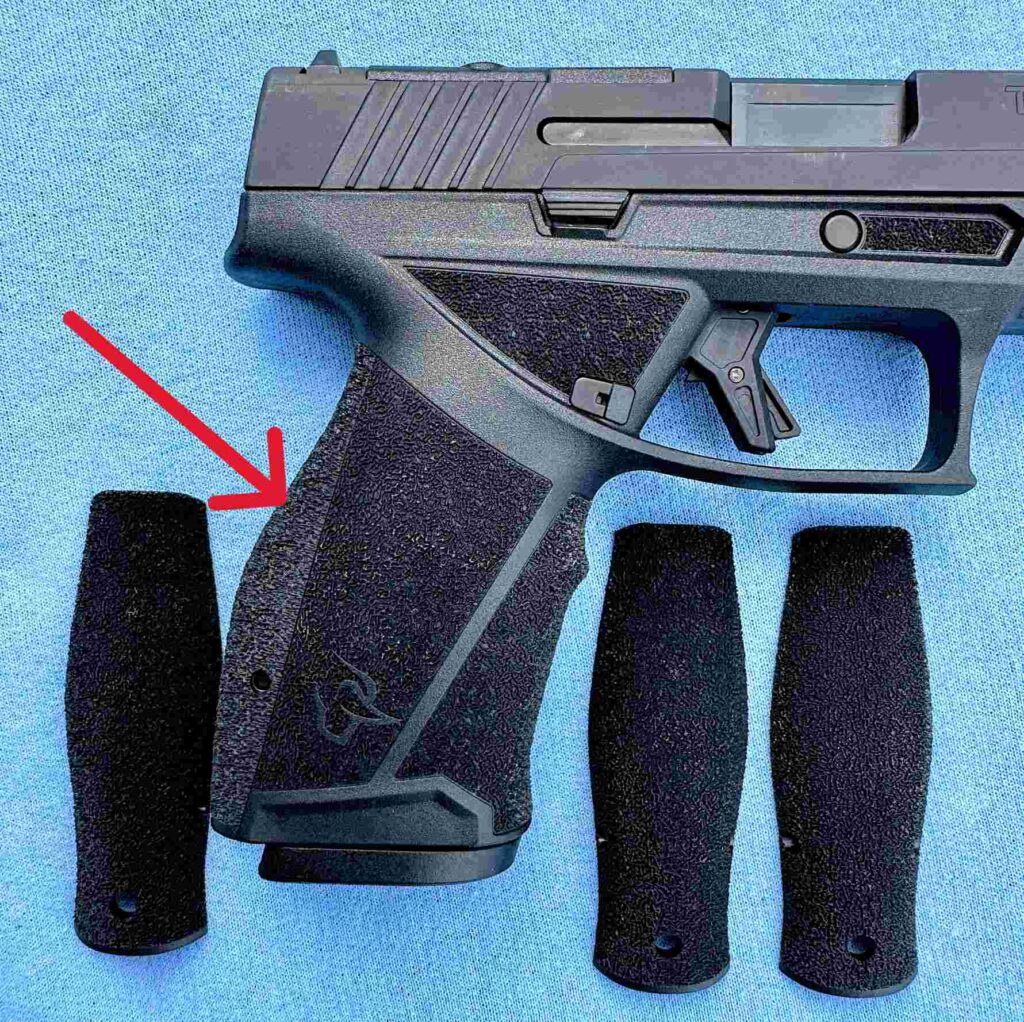
The frame/grip is black polymer and has a Picatinny rail integral with the dustcover for mounting lights or lasers. Ample-sized, the trigger guard is squared in front, and just above it on both sides is a textured indexing pad. Just above the above the trigger, on the left side of the frame, is the low-profile takedown latch. Further back on the frame are bilateral slide-stop levers, and behind the trigger, is a reversible magazine catch. The grip frame is stippled over most its surface area, plus there is a small finger groove below the trigger guard. The TX9 comes with 4 interchangeable backstraps, held in place by a pin, to allow the user to properly fit the gun to their hand. Also included are two blue steel Mec-Gar magazines with polymer bases and witness holes on the rear surface.
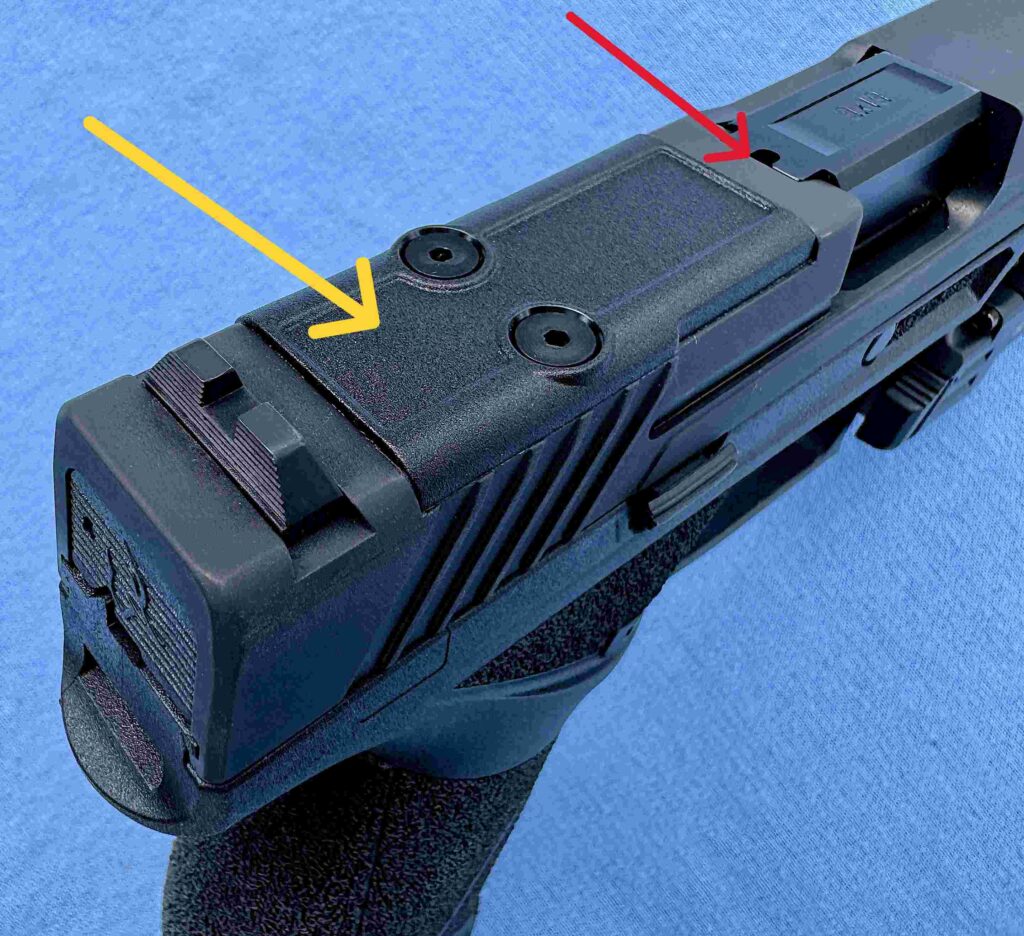
Contained within the polymer frame is a stainless-steel inner frame unit containing the firing mechanism. The TX9 has no external manual safety, but there’s a firing pin block and trigger safety. A captured, concentric recoil spring rides beneath the barrel. Takedown is fast and simple; I won’t detail it here; the instructions are in the owner’s manual. The TX9 is considered single action only and its trigger is almost 0.50” wide; with a grooved safety insert. The trigger, had about 0.36” of take-up, and my trigger pull gauge showed an average pull weight of 5.85 lbs., with no overtravel. Kudus to Taurus on the overall fit and finish. Each TX9 comes in a plastic, foam-lined carrying case with a safety padlock, an owner’s manual, and a registration form for a limited lifetime warranty.
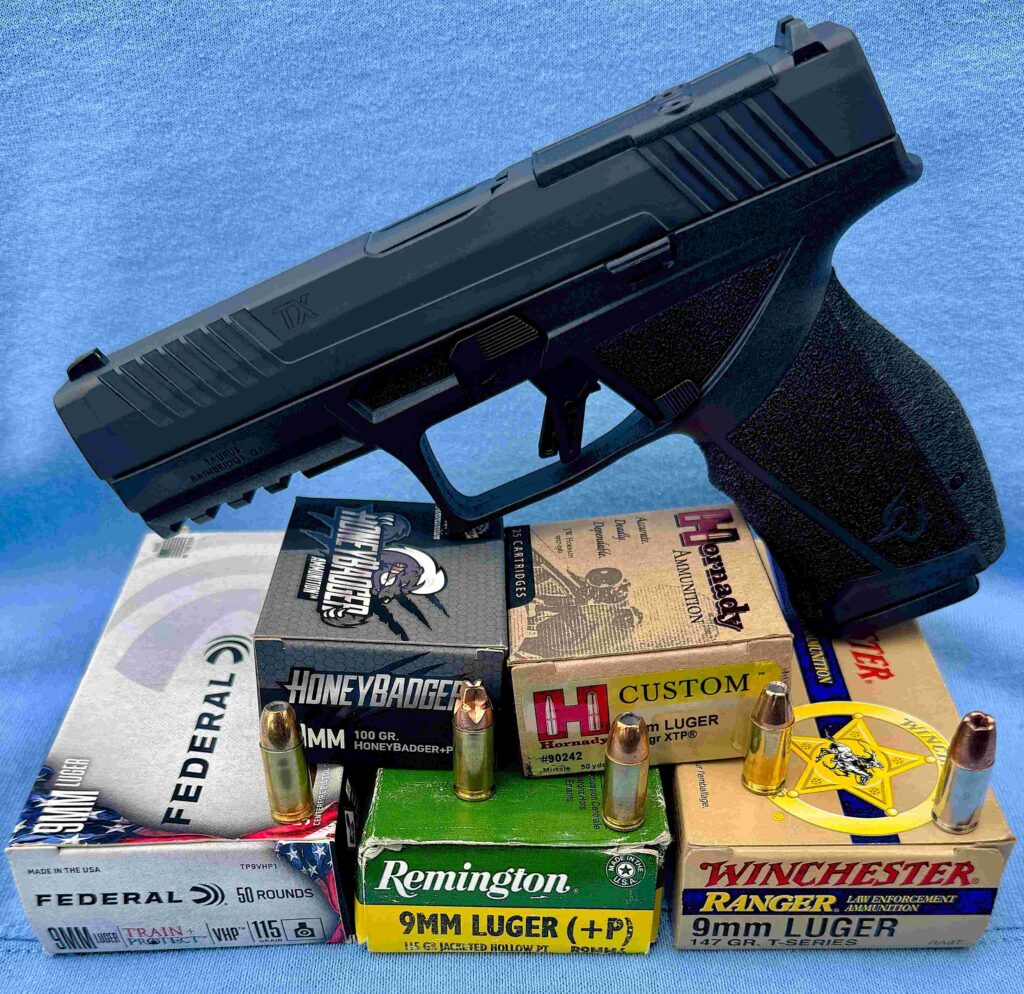
I selected five different 9mm loads for the TX9 T&E that are suitable for duty/defense usage. The first was Black Hills Honey Badger that has a 100 gr. solid copper bullet with a fluted nose forming an X-shape, and is rated +P. Second was Federal Train + Protect, a standard-pressure load with a 115 gr. JHP; the jacket is skived from the nose back to the bullet bearing surface. Third was Hornady’s Custom cartridges with a 124 gr. cone-shaped XTP HP that has a skived nose. Forth a Remington High Velocity +P load, which carries a 115 gr. JHP with skived nose. Number five was Winchester Ranger LE ammunition, which has a 147 gr. T-Series JHP bullet.
For a simulated “Duty Rig” I matched up a duty belt, holster, and accoutrements of black nylon from Uncle Mikes and 5.11 Tactical. My duty combination consisted of a 2” wide duty belt, high-ride thumb-break holster, single magazine pouch, cuff case, baton/flashlight ring, and 4 belt keepers. This outfit was similar to the duty gear I used with U.S. Customs when we transitioned to a 9mm pistol in the early 1990’s.
The TX9 is “duty ready” per Taurus, and they define this as, “…the philosophy driving the Taurus TX9. The Taurus TX9 is designed from the ground up for the toughest environments and maximum performance.” It’s built to withstand the rigorous testing normally done by a LE agency or military unit prior to adoption. With the foregoing in mind, my T&E followed my standard test protocol with an added element.
My first step on range day was bullet velocity measurements and a sight alignment check. I did not to use the T.O.R.O. system for an optic, and relied on the factory sights. The five 9mm test loads were fired through my Garmin Xero C1 Pro chronograph, and I’d sent a Birchwood Casey Shoot-N-C B27 target center to the 10-yard line, to see how well the sights were regulated. Point of aim/point of impact (POA/POI) was good, and the bullet velocity data can be seen in the performance table.
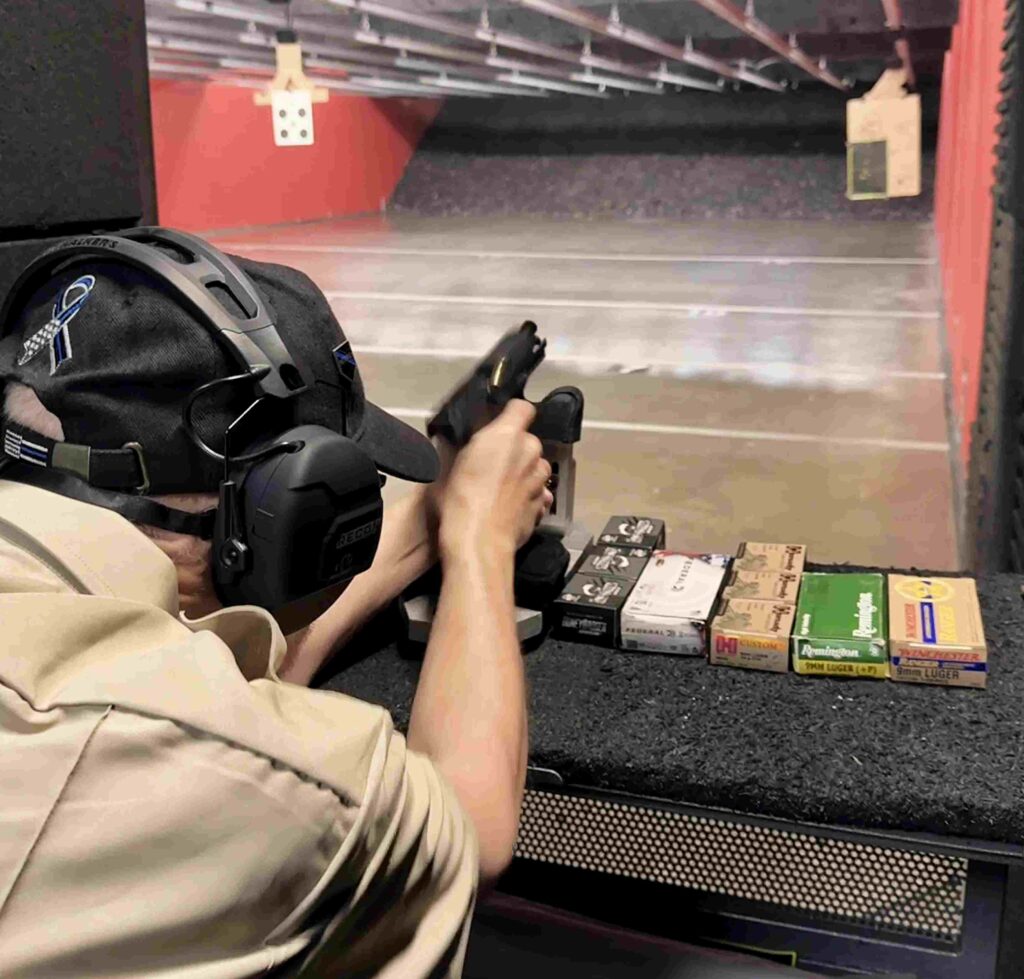
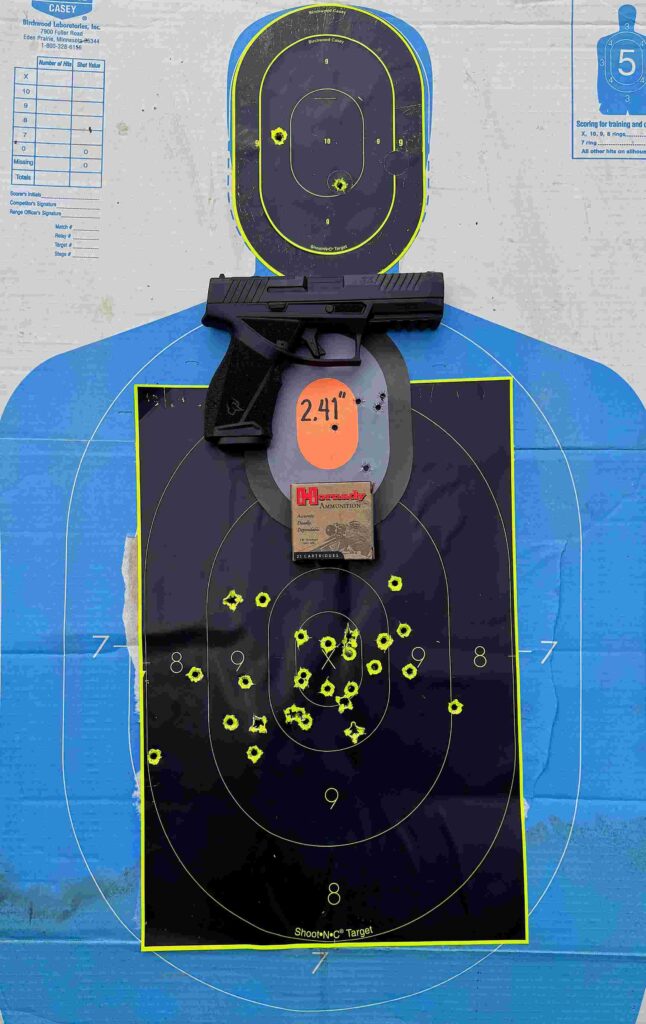
To assess accuracy potential, I used 7.5” x 5.5” oval-shaped targets, posted at 15 yards. Three 5-shot groups were fired with each of the 5 test cartridges; all shooting was done from the bench, using a Ransom Steady Rest. That day, I was having some trouble with carpal tunnel in my right wrist, and my groups could have been better. My best 5-shot group measured 2.41” using the Hornady Custom load. Second and third place went to the Federal and Remington loads. Group averages ranged from 2.82” to 5.54.” All the data is included in the performance table.
For a practical “duty type” exercise I used a combat qualification course that was once standard for U.S. Customs. I put on my Uncle Mike’s/5.11 Tactical duty rig, and each stage began with the TX9 holstered. The course has four stages with 30 shots, so I loaded both magazines with 15 rounds of mixed test cartridges. A B27 silhouette target from Birchwood Casey was used with self-adhesive Shoot-N-C target overlays on the head and center-mass zones. Stage one began at 5 yards with 6 shots fired with the dominant hand, a mag change, and transition to the support hand, and 6 more shots were fired. For stages two and three, the target was moved to 7 yards. First, was a series of 3 double-taps, then after a mag change, a failure drill was performed twice with 2 center-mass shots, and 1 head shot, then a mag change. For the final stage, the target was moved to 15 yards, and I used my shooting bag as a make-do barricade. Two shots were fired standing, left-side barricade, 2 shots standing right-side barricade, then 2 shots kneeling, right-side barricade. Between each stage a 360°threat assessment was made before re-holstering.
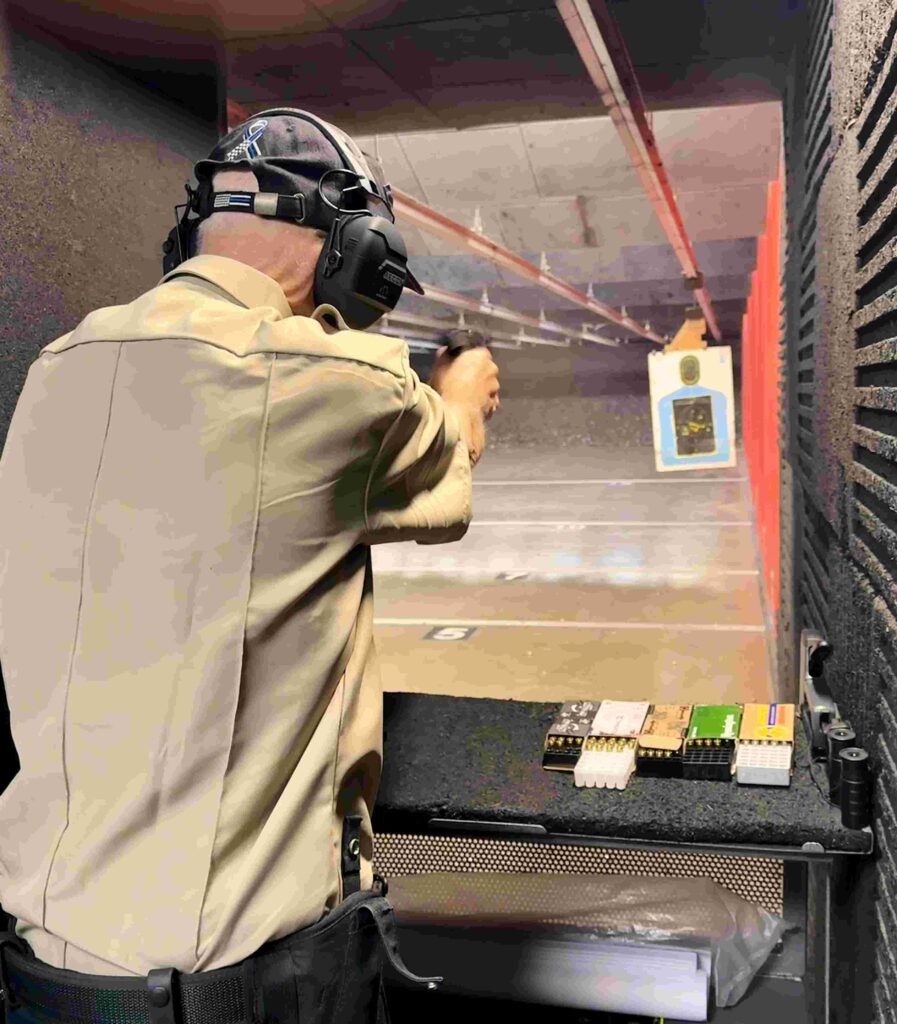
I performed a limited reliability test using both magazines, fully loaded, with 17 rounds of mixed test ammo. Another B27 target center was sent to 10 yards, and then standing, with a two-handed hold, I emptied the TX9 at a steady cadence. I changed mags and again, emptied the TX9. I wasn’t measuring accuracy, but noted that I kept all my bullet impacts inside the 8, 9, 10 and X-Ring scoring zones.
The most important requirement for a duty gun is reliability. The Taurus TX9 satisfied this dictum, as during the shooting of 164 rounds of 9mm factory ammunition, I didn’t have a single malfunction. It demonstrated practical accuracy with an overall group average of 3.07” at 15 yards. My score on the USCS combat/qualification score was 286/300, passing is 270, so I no complaints about the guns performance. While this wasn’t a torture test, nothing broke or came loose during the shooting session. I didn’t change the backstrap that was on the TX9 when I received it, as it fit my medium-sized hand quite well. The stippling on the grip frame kept the gun from slipping in the hand while firing, and helped control muzzle-flip. Recoil, even with the +P rounds, was easily managed.
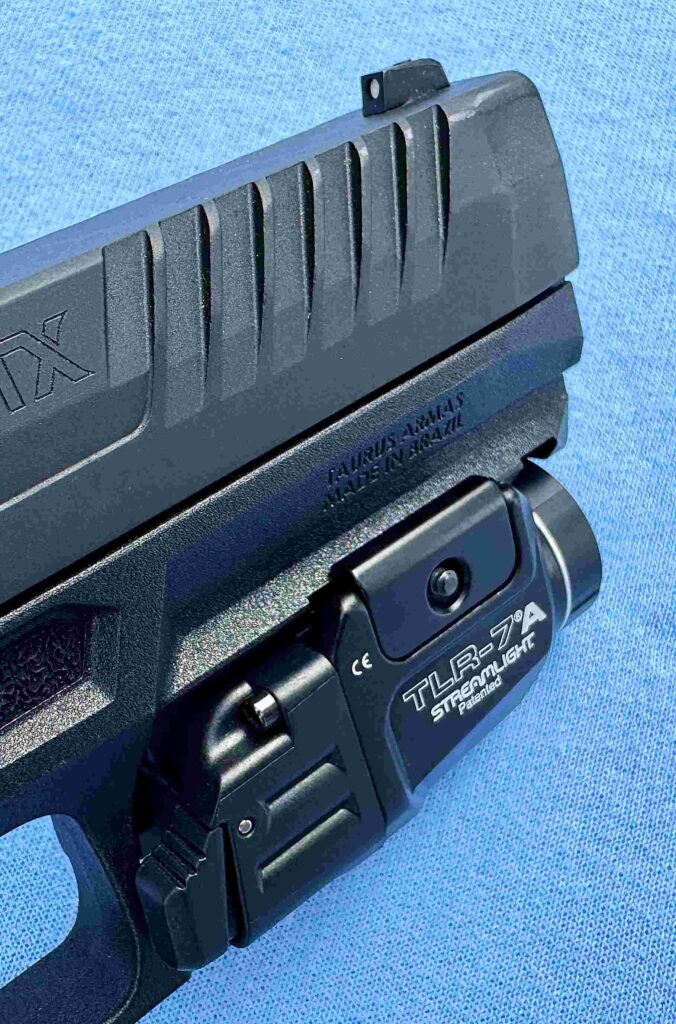
During the T&E, I wanted to try the TX9 with a tactical light, so I attached a Streamlight TLR-7A flashlight, and seated it in the last notch of the Picatinny rail nearest the trigger guard. I found the lights activation switch was easy to use with the support-hand thumb. The Guns controls were easy to reach and use, plus empty mags dropped out with no issues. A slight bevel on the inside surfaces of the mag well helps with quick magazine insertion for reloads.
The only item that I found wanting was the factory sights. They are very small, which contributes to a low profile, but I’d like to see them increased in size, with perhaps a white square beneath the rear sight notch. I doubt that these sights will co-witness with an optic, and would have to be replaced with higher sights for this to work.. When all is said and done, if I was still serving as a uniformed LEO, I would have no heartburn about packing the Taurus TX9 as my service pistol.
Taurus TX9 Duty-Size Specifications
MECHANISM: Locked-breech, semi-automatic, striker-fired
CALIBER: 9mm Luger
CAPACITY: 17+1
BARREL: 4.5”
OA LENGTH: 7.75”
EMPTY WEIGHT: 25 oz.
SIGHTS: Fixed in dovetail rear black – white dot front
FINISH: Frame black polymer, slide black gas nitride
STOCKS: Stippled polymer w/ 4 replaceable backstraps
MSRP: $499.00
Taurus TX9 Duty 9mm Performance
|
Cartridge |
Ave. Velocity |
Best Grp. |
Ave. Grp. |
Ft-Pounds Muzzle Energy |
|
Black Hills Ammunition 100 gr. Honey Badger Solid +P |
1210 FPS |
2.49” |
2.53” |
325 FPE |
|
Federal Train & Protect 115 gr. JHP |
1090 FPS |
2.44” |
3.54” |
303 FPE |
|
Hornady Custom 124 gr. XTP-JHP |
1092 FPS |
2.41” |
2.82” |
328 FPE |
|
Remington High Velocity 115 gr. JHP +P |
1220 FPS |
2.45” |
2.89” |
380 FPE |
|
Winchester Ranger LE 147 gr. T-Series JHP |
954 FPS |
3.07” |
3.18” |
297 FPE |
NOTE: Bullet weight measured in grains, velocity in feet per second, 15” from the muzzle by a Garmin Xero C1 Pro chronograph, and accuracy in inches for three 5-shot groups at 15 yards.
To locate a dealer near you visit www.lipseys.com/dealerfinder