
If you walk into any successful gun store you will see something immediately: the best retailers don’t just sell firearms—they create an experience.
Today’s consumers have more options to buy than ever. Big-box retailers, online marketplaces and direct-to-consumer marketing mean independent FFL dealers must offer something that can’t be put in a cardboard box. The stores that succeed are those that turn shopping from a transaction into an engaging experience that keeps customers browsing longer, buying more and returning frequently.
In the case of merchandising strategy and store layout you can increase average transaction value and customer satisfaction and create a place that people really enjoy visiting.
Starting With the Customer Journey.
Most gun stores are designed around inventory storage, not customer flow. Security and operational efficiency are critical but it’s also important for dealers to look at how customers move through the store.
The most successful retailers create a natural pathway for customers to go through and explore.
Instead of positioning customers directly in front of the firearm counter and ending the shopping experience before it begins, create a pathway that guides them through key product categories first. Accessories, optics, ammunition, hunting gear and impulse-purchase items should be visible before customers reach the firearm sales counter.
The longer customers are buying products, the more possibilities there are for add-on sales.
Think about how outdoor retailers and sporting goods stores make their businesses work. Outdoor retailers and sporting goods stores provide opportunity for discovery on every corner of the store. Gun stores do the same.
Create Lifestyle-Based Displays
One of the biggest merchandising mistakes dealers make is to organize products strictly by manufacturer or product type.
Customers don’t always shop that way.
Rather, create lifestyle-based displays that enable customers to see full solutions.
Consider creating themed merchandising zones like:
The Whitetail Hunter
The Home Defense Setup
The New Shooter Starter Kit
The Competition Shooter Package
The Waterfowl Hunter’s Corner
The Everyday Carry Center
Each display should have firearms, optics, ammunition, accessories, apparel, and supporting gear that work together.
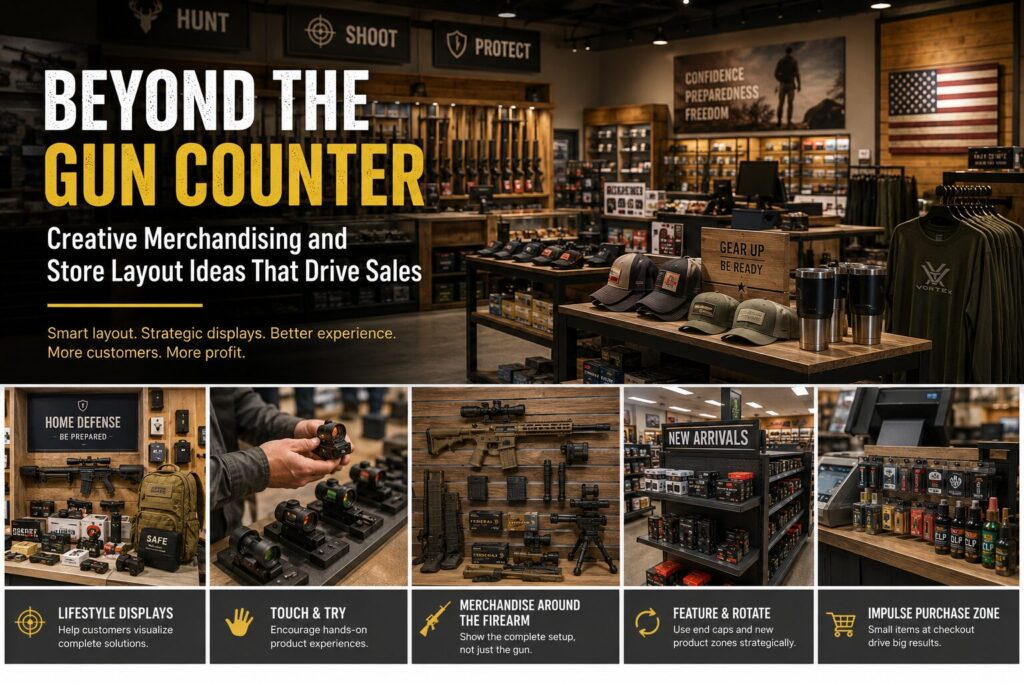
When people can see more of the whole thing than individual products, average ticket values tend to be very high.
Build a “Touch and Try” environment.
Consumers want to touch things before buying products.
As far as possible, encourage hands-on experiences with non-regulated merchandise.
Create areas where customers can:
Compare red dots side-by-side
Handle holsters and belts
Test bipods and shooting rests
Feel different trigger shoes and grips
Test backpacks and range bags
A product’s physicality is emotionally significant, so the more people physically engage with it the more emotionally invested they become.
A customer holding a product is often much closer to buying than a customer simply looking at it through glass.
Merchandise Around the Firearm
Many retailers treat accessories as an afterthought.
All guns should have a story.
Instead of displaying a rifle alone, sell it alongside:
Compatible optics
Sling options
Magazines
Cleaning supplies
Ammunition
Cases
Mounting hardware
Make visual cues that give the customer’s next question a visual cue to answer it before they ask it.
A customer purchasing a rifle isn’t buying a rifle—they’re buying everything needed to enjoy it.
Make those additional purchases obvious and convenient.
Use End Caps Like a Marketing Department
End caps are prime real estate.
Rather than filling them with random overstock, use them strategically.
Rotate monthly themes like:
Turkey Season Essentials
Father’s Day Gift Ideas
Concealed Carry Upgrades
Long-Range Shooting Setup
New Product Spotlight
Staff Picks
With fresh displays, fresh displays create a sense of movement in the store and encourage repeat customers to see what’s new.
Even customers who visit regularly will notice changes and spend more time browsing.
Create an “Impulse Purchase Zone”
The area around the checkout counter is still one of the most underutilized areas in many gun stores.
Small-ticket items can generate significant revenue when properly displayed.
Consider featuring:
Targets
Batteries
Gun oil
Bore snakes
Ear plugs
Patches
Stickers
Pocket lights
Multi-tools
Cleaning cloths
These products are usually not very difficult to sell and in many cases can considerably increase average transaction values.
Make the Store Instagram-Worthy
Social media influences buying decisions made by dealers, whether or not they like it.
You could add a visual element that customers want to photograph.
Examples include:
A vintage firearm wall
A local wildlife mural
A custom American flag display
A historical firearms timeline
A trophy wall featuring local hunters
When customers take photos and share them online, they become brand ambassadors for the store.
Free marketing is still the best marketing.
Add Educational Zones
Many consumers—particularly new shooters—feel intimidated when entering a gun store.
Educational displays can reduce anxiety and increase trust.
Consider creating informational stations that cover:
Firearm safety
Caliber comparisons
Suppressor basics
Optics selection guides
Hunting regulations
Concealed carry considerations
When customers view your store as a trusted resource rather than just a retailer, loyalty increases.
Education engenders confidence, and confidence engenders purchases.
Use Lighting as a Sales Tool
Lighting is one of the most overlooked merchandising tools in firearms retail.
Bright, targeted lighting can dramatically improve product presentation.
Highlight:
New arrivals
Premium firearms
Featured optics
Seasonal displays
Luxury retailers have understood this concept for decades.
A well-lit product appears to be more valuable than the same product in poor lighting.
Create a “What’s New” Destination
Customers love discovering new products.
Dedicate a prominent area near the entrance to new arrivals.
This gives repeat customers an immediate reason to stop and browse.
It also enables sales staff to naturally start talking about the latest products entering the market.
A simple sign that reads “Just Arrived” can go on to be one of the most effective sales tools in the building.
Encourage Longer Visits
The longer customers stay, the more they spend.
Consider adding:
Comfortable seating areas
Coffee stations
Hunting and shooting magazines
Local hunting reports
Community bulletin boards
Digital range videos
Stores that feel welcoming become gathering places.
Gathering places become destinations.
Destinations create loyal customers.
The Bottom Line
Successful merchandising is not about having more inventory. It is creating an atmosphere that is conducive to the visualization of customers’ next hunt, next range trip or their next gun purchase.
FFL dealers who concentrate on customer experience have an edge that online retailers cannot compete with.
And as a result, a store layout of a more thoughtful sort, good displays, educational opportunities and creative merchandising strategies can really change your ordinary gun shop into a place people enjoy visiting.
In today’s competitive retail environment, that experience may be the most valuable product on the shelf.
To stock your store with the best in the industry visit www.lipseys.com
To locate a dealer near you visit www.lipseys.com/dealerfinder