
In 1959, the Mattel Toy Company came out with a cool addition to their line of plastic-bullet shooting cap guns; it was called the Remington Derringer 1867. It was a metal, single-shot derringer that attached to a belt buckle via a hinged arm that locked into place. It looked like a fancy, nickel-plated belt buckle, until you quickly pooched out your belly, and the little derringer flipped out on its hinge and fired. That is, if you had cocked it ahead of time and had it loaded with a “Shootin-Shell,” plastic bullet that was propelled by a small spring inside the cartridge case. On the base of the plastic cartridge, you fastened a round, self-adhesive “greenie Stik-M-Cap,” which went “bang!” How cool is that? I got one for my 6th Birthday, and that little buckle gun got me into some trouble in the 1st Grade. More innocent times…
The North American Arms Buckle Gun
In 1984, North American Arms received a patent for a belt buckle that would hold a mini-revolver. They made several versions; one was rather small and held a tiny mini-revolver in .22 Short. Last year to commemorate their 50th year, they produced an ornate, gold embellished buckle, with a matching 1-1/8” barrel mini-revolver in .22 Long Rifle (LR). At the 2026 SHOT Show I saw a new model called the Long Rifle Oval Ornate Belt Buckle (NAA-22LR-BBO), which includes a 1-1/8” standard model mini-revolver in .22 LR. On March 2nd, I received a press release from NAA about another new variation, this one was called the “Chuckwagon,” (NAA-22MS-BBO) and its belt buckle holds a 1-1/8” mini-revolver in .22 Magnum. Now, I was interested!
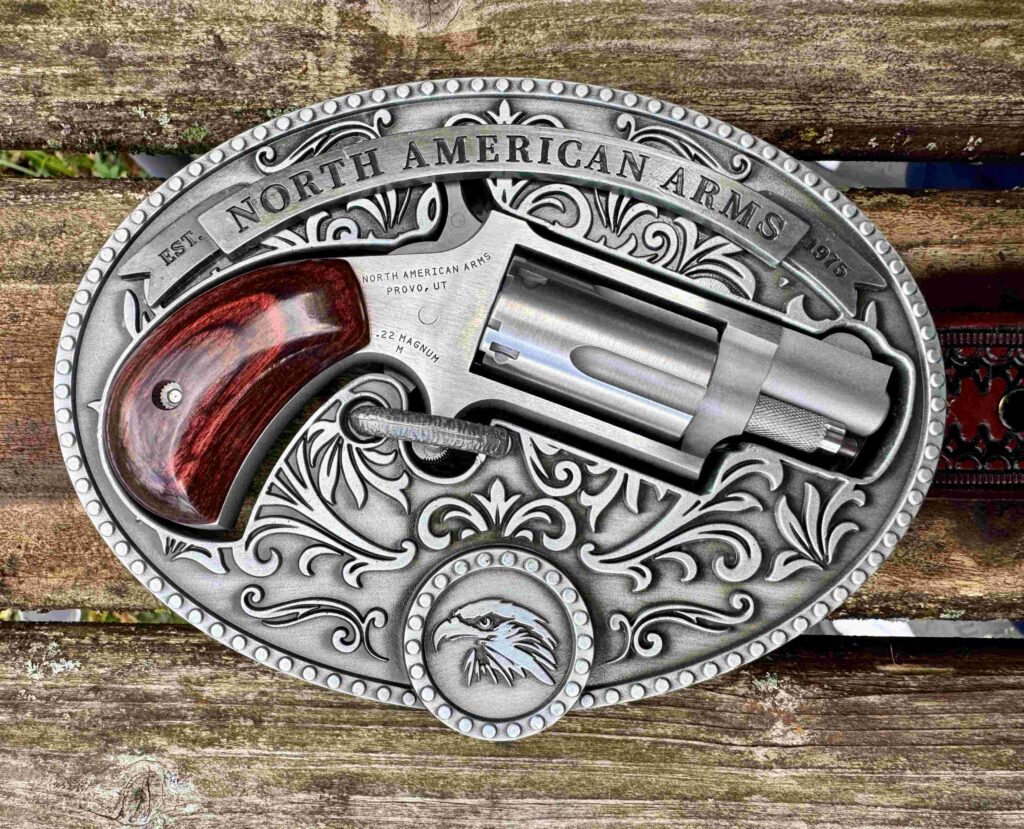
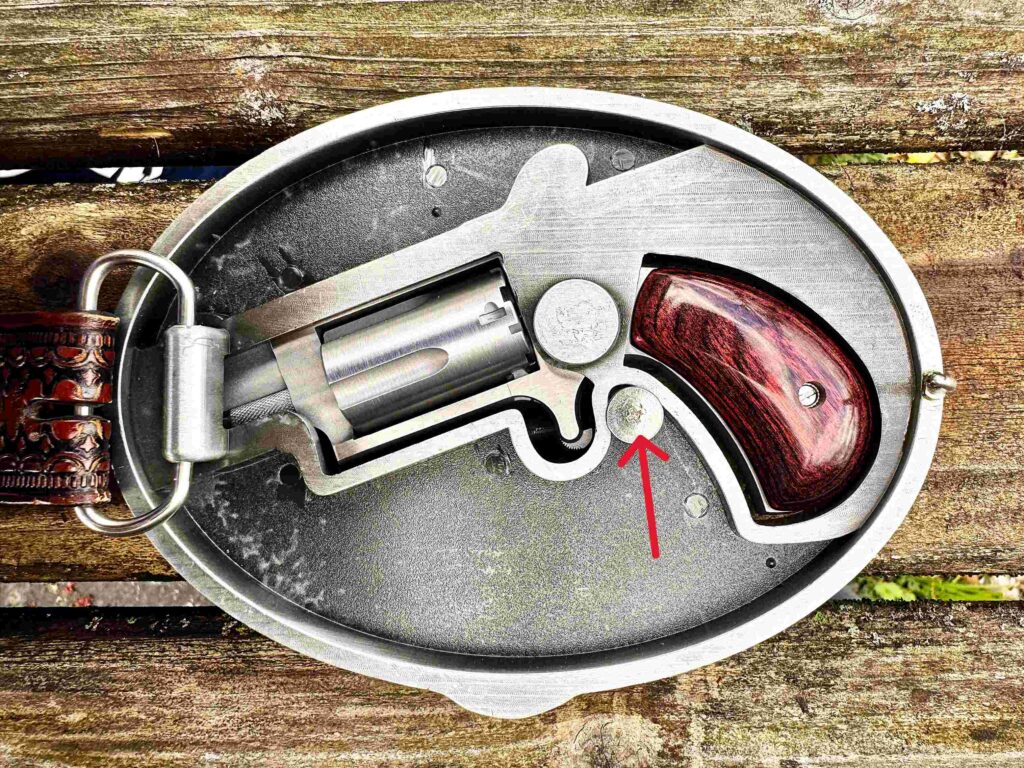
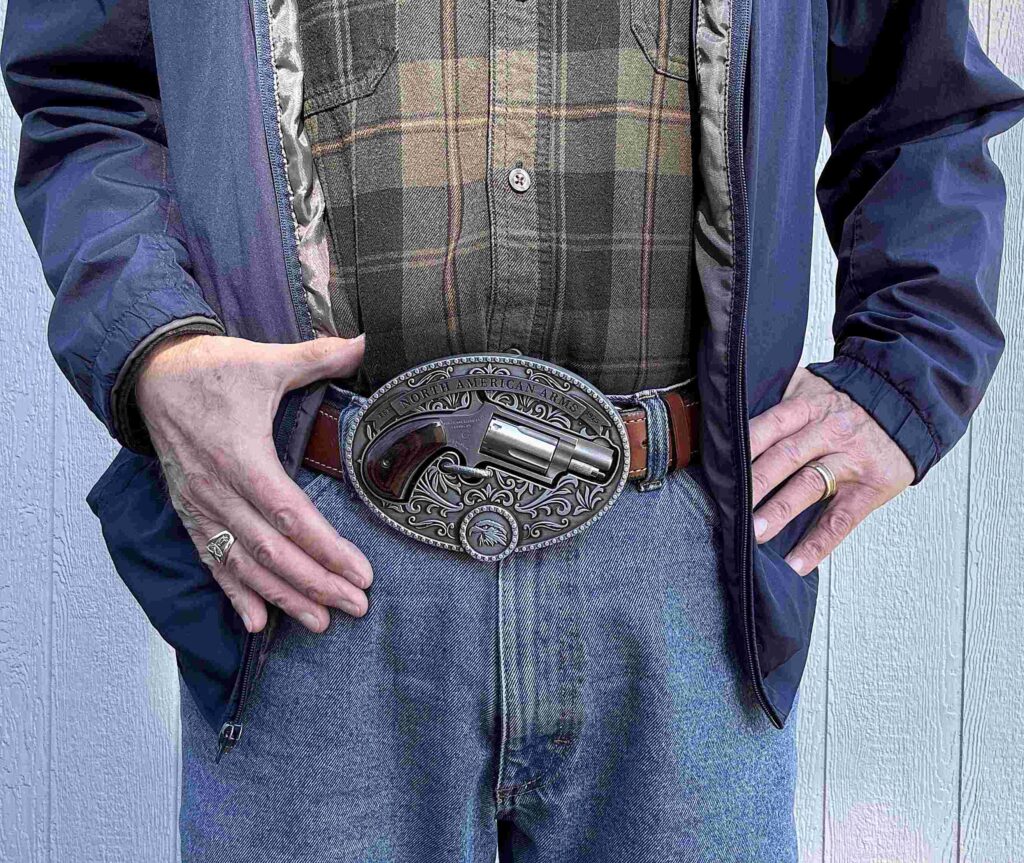
NAA shipped me a test sample of the “Chuckwagon,” and it came inside their steel, lockable, carrying case, lined on the inside with foam rubber. The buckle itself is oval-shaped, 5-1/2” wide, with a height of 4-1/4.” It is pewter in color and judging by the weight (25.4 oz w/ gun), it might well be made of pewter. Across the top is a banner imprinted with Est. NORTH AMERICAN ARMS 1975, and on the bottom is a circle with the NAA eagle head logo. In between is a raised floral motif, plus the cut-out for the mini-revolver. By necessity, the buckle is 5/8” thick and on the back, the cut-out exposes the barrel, cylinder, and grips. The mini-revolver is held in place by the tip of the hammer spur, and a spring-loaded arm that closes over the spur trigger. To release the gun, the flat face of the arm (on the back) must be pressed inward, allowing the arm to be moved down and out of the way. It’s a rather secure arrangement.
As to the mini-revolver, it is a standard .22 Magnum Short Barrel (NAA-22MS). This all stainless-steel, matte-finished, five-shooter is a single action (SA), meaning one must cock the hammer manually to fire it. This is facilitated by a high and serrated spur. It is actuated by a spur trigger, that is partially protected by a projection of the frame. The trigger protrudes outward slightly when the hammer is at full cock. Trigger pull weight is in the vicinity of 8-9 lbs. Overall length of the NAA-22MS is 4.63”, with a height of 2.81” and an empty weight of 6.2 oz. It has a ribbed barrel with a half-moon front sight and a fixed notch rear sight. It has two-piece rosewood birdshead grips.
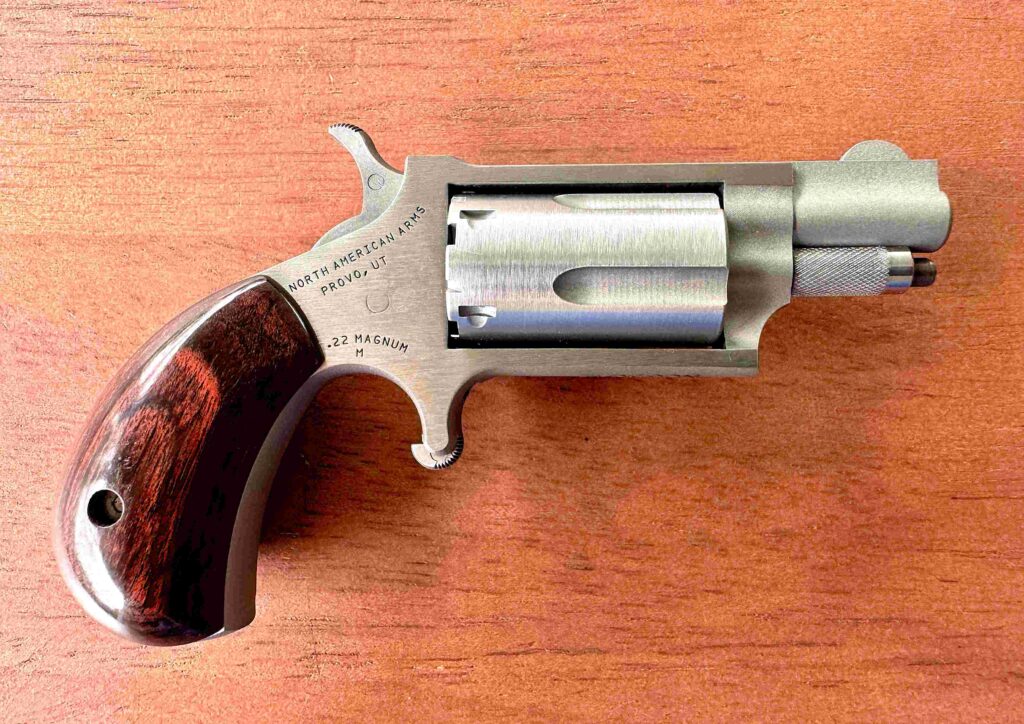
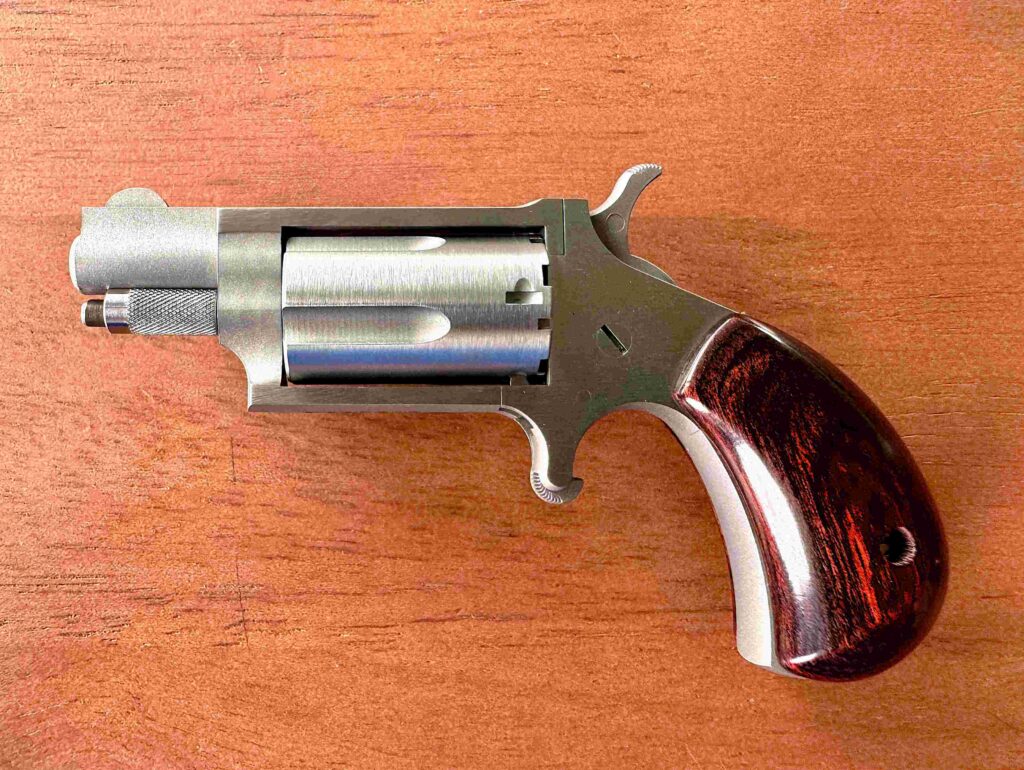
In order to load the mini-revolver, the fluted cylinder must be removed. First be sure the gun is unloaded and the hammer is pulled back to the first “click.” At the front of the knurled base pin (below the barrel), is a spring-loaded pin. Press in on this pin and the base-pin can be slid forward and removed. You can now push the cylinder out of the frame window. If the gun has been fired, the base-pin can be used to punch out the empty cartridge cases. Load the cylinder with .22 Magnum cartridges, replace the cylinder in the window, and re-insert the base-pin making sure the little ball-dent is turned up against the barrel. The frame has no recoil shield on either side, so the base of the loaded rounds is easily seen. There are also 1/8” notches cut into the rear of the cylinder that act as loaded chamber indicators. The smaller notches between the chambers are a safe resting place for the hammer-mounted firing pin.
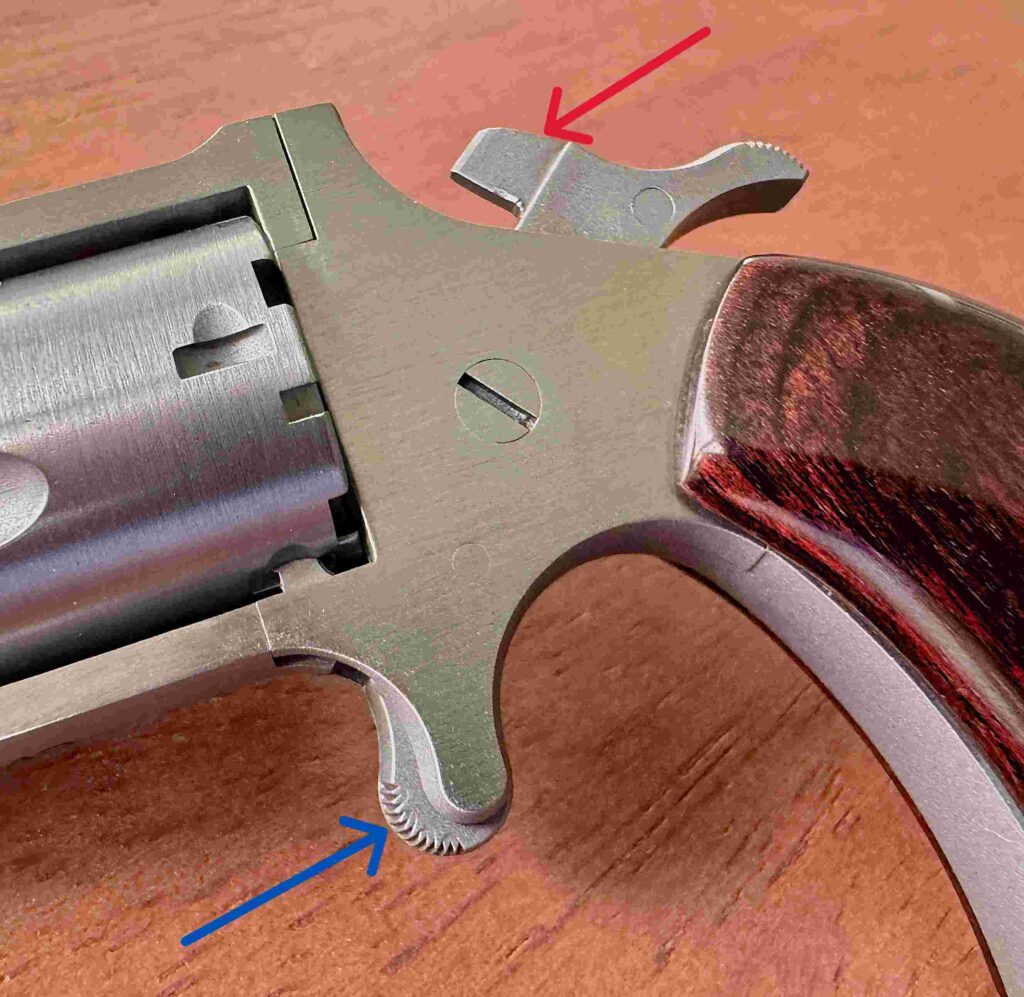
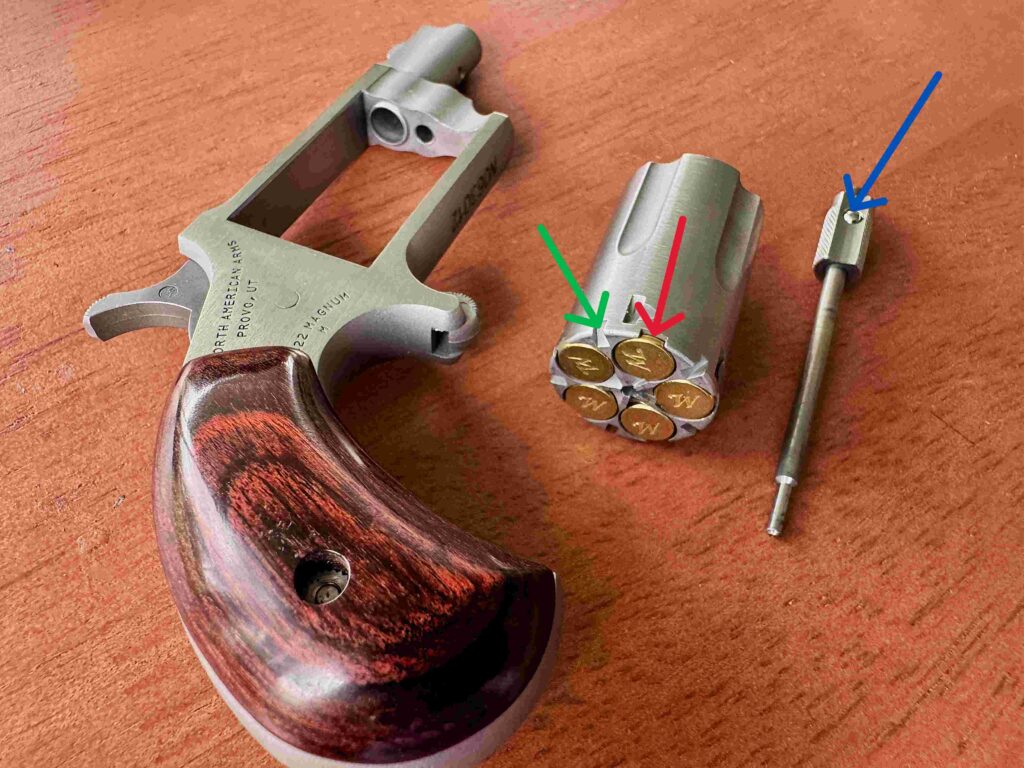
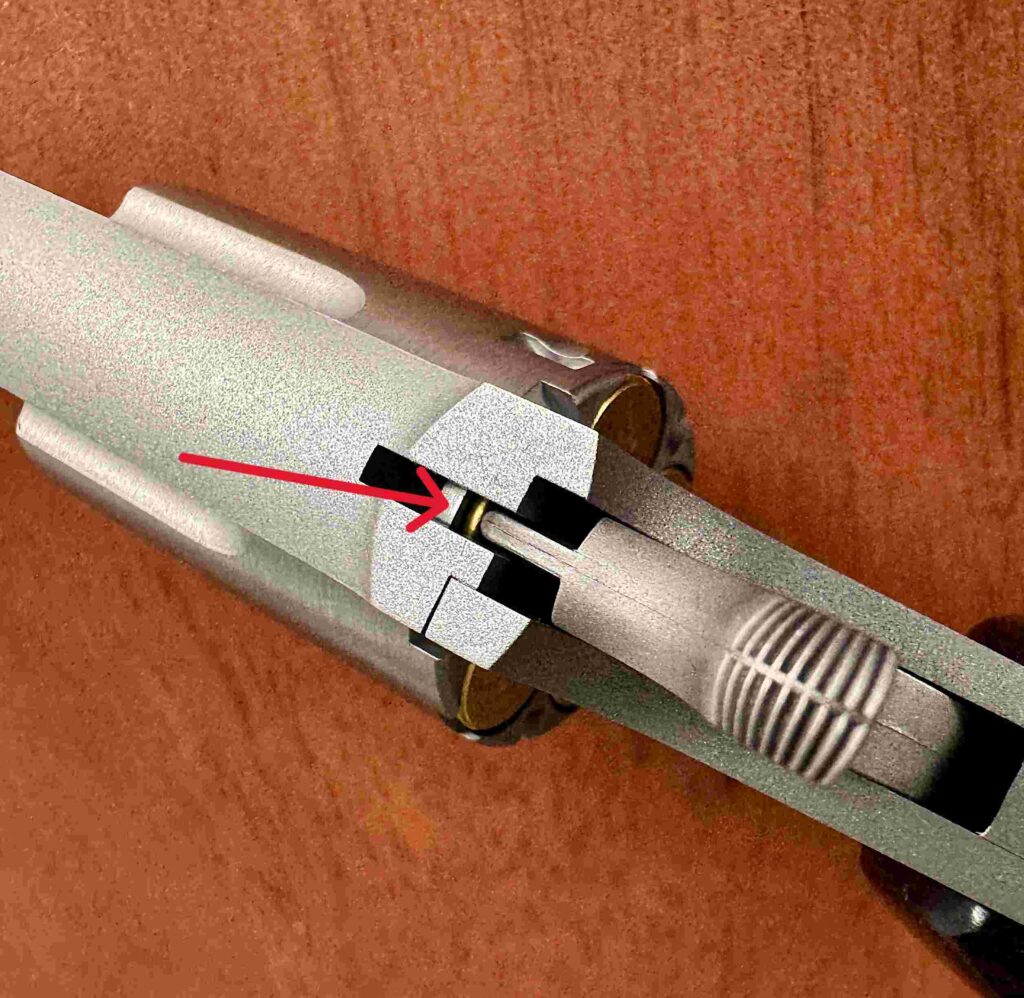
Prepping and Testing
Nobody is going to buy a Chuckwagon with a .22 Magnum mini-revolver to take out plinking. IMHO it has only one use and that’s self-defense. That being said, the .22 Magnum cartridges I chose to use in my evaluation are all marketed for defense use. Alphabetically, the first is CCI Uppercut Defense. This is a fairly new round and features a 40 gr. copper-plated HP bullet with nose skiving that promotes full and reliable expansion. The factory-listed velocity is 1050 FPS, which I presume in from a short barrel. Next, is the Hornady Critical Defense, which is loaded with a 45 gr. FTX JHP bullet. The hollow bullet nose is capped with a Flex Tip insert which prevents clogging of the HP when passing through clothing or barriers. It has a listed velocity in handguns of 1000 FPS. Another selection was Speer Gold Dot Personal Protection Short Barrel. It carries a 40 gr. Gold Dot HP bullet designed to work in short barrels and is touted to have both reliable expansion and penetration. It also has a 1050 FPS factory-listed velocity. The fourth round I elected to use is Winchester Silvertip. Per the box, it is loaded with a 40 gr. Defense JHP “Optimized for Handguns.” The bullet is a conventional-looking exposed lead JHP. The factory velocity shown was 1320 FPS, which is probably from a long test barrel.
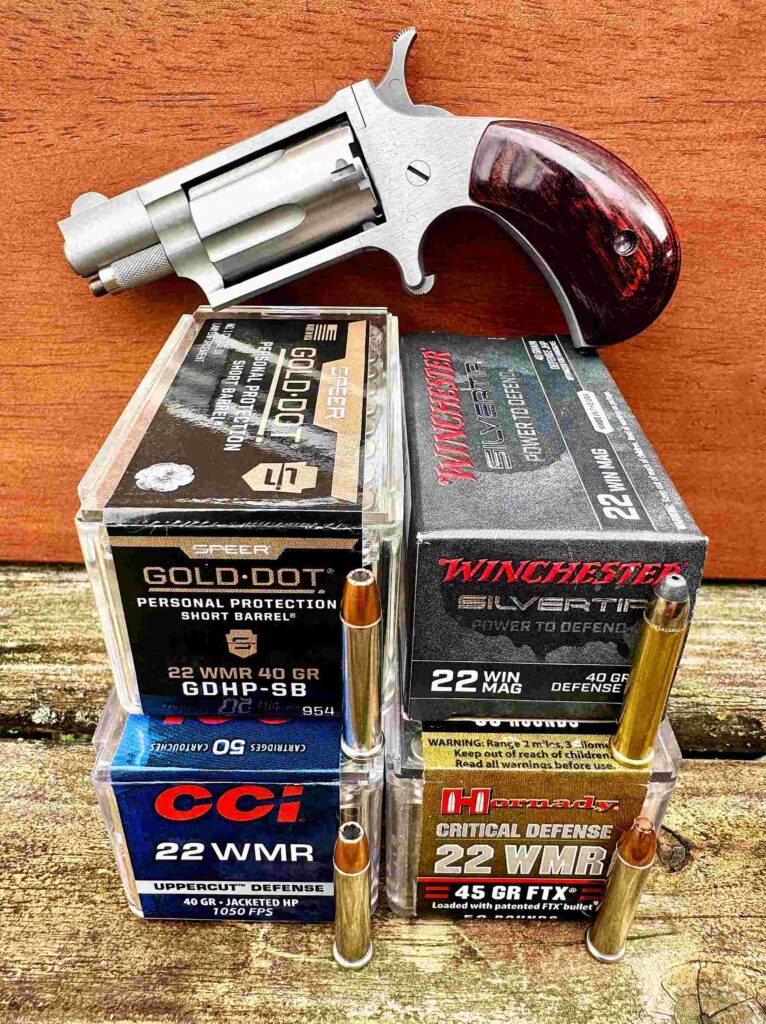
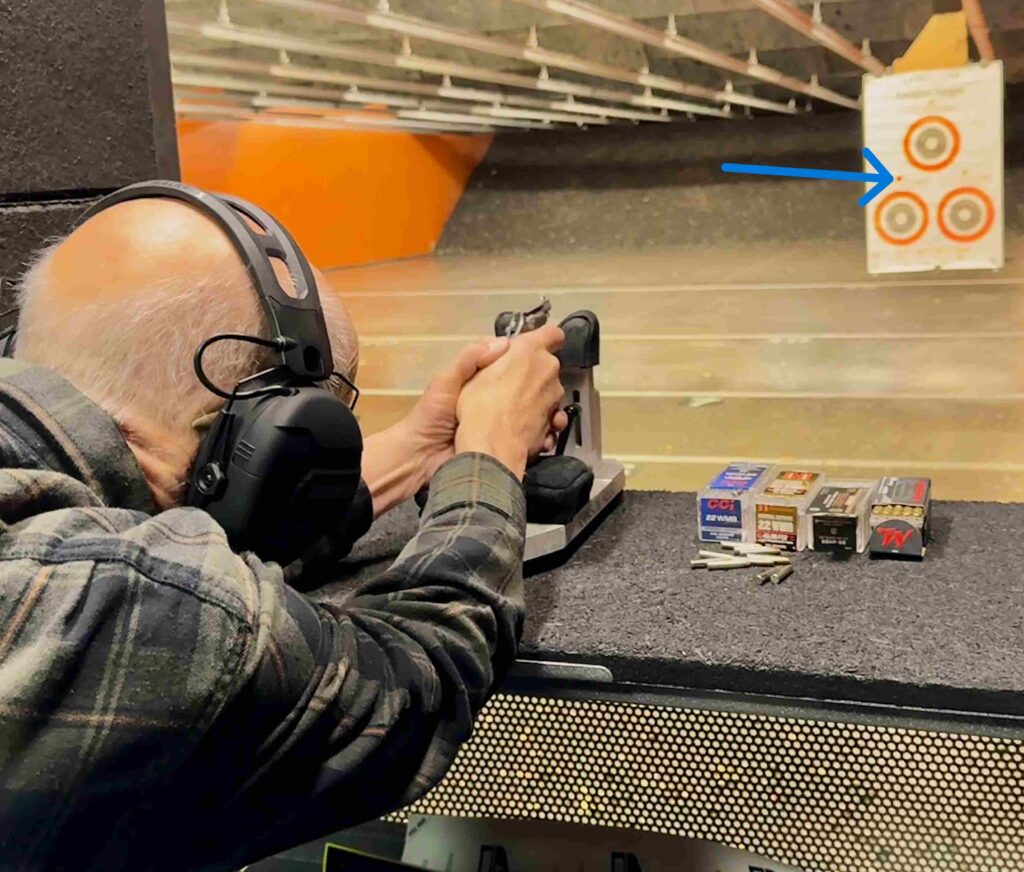
My first job at the range was to set up my Garmin Xero C1 Pro chronograph and measure the velocities from the NAA-22MS 1.13” barrel. I also sent a B-27 center target down to the 5-yard line to see how the guns miniscule sights were regulated for the four .22 Magnum test cartridges. All the chronographing and subsequent accuracy testing was done from the range bench, using my Ransom Steady Rest. I was surprised at the velocity readings with this short barrel; you can check them out in the performance table. The sights were off elevation-wise, most of the bullet impacts were 5-6” below the point of aim.
During the accuracy test I had to aim just above the outer ring of the bullseye targets to get center hits. For the accuracy potential evaluation, I sent a three-bullseye target down to 7 yards. The bullseyes were 9.75” in diameter. My best 5-shot group was made using the Winchester Silvertip cartridges and it measured 1.39.” Runner up was the Hornady Critical Defense with a 1.82” group. Considering the sights, plus the stiff trigger pull, and even with some bullet “keyholing,”the average for all the groups came to 2.16.” All the group data is in the performance table.
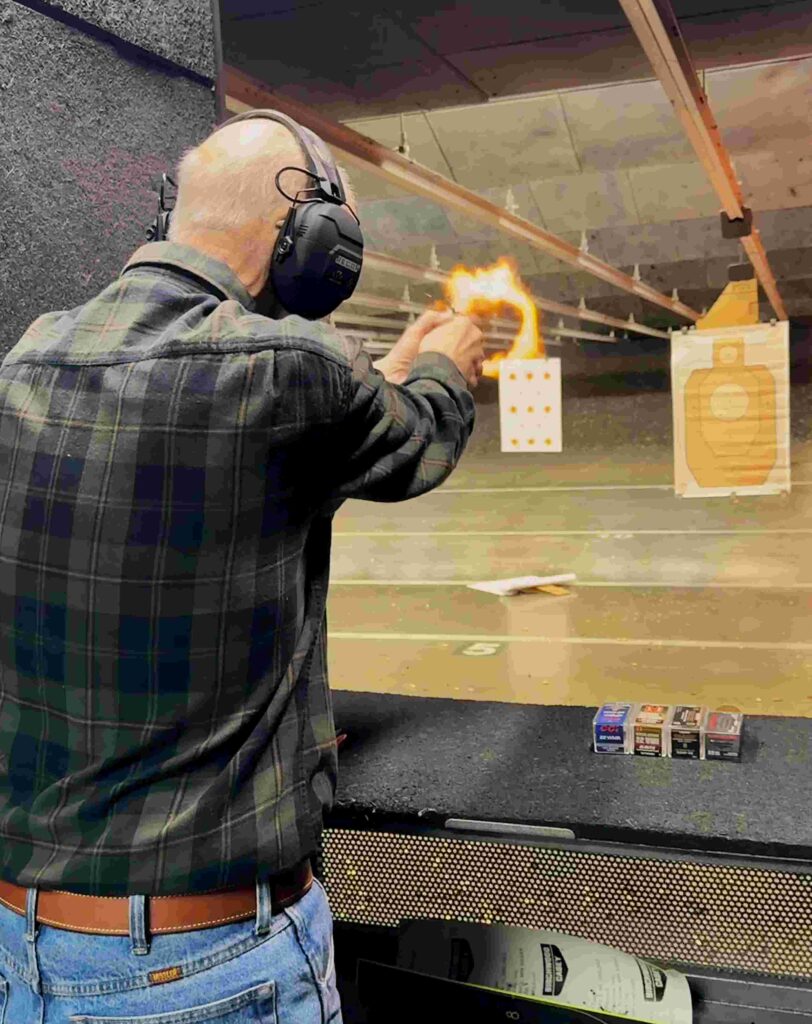
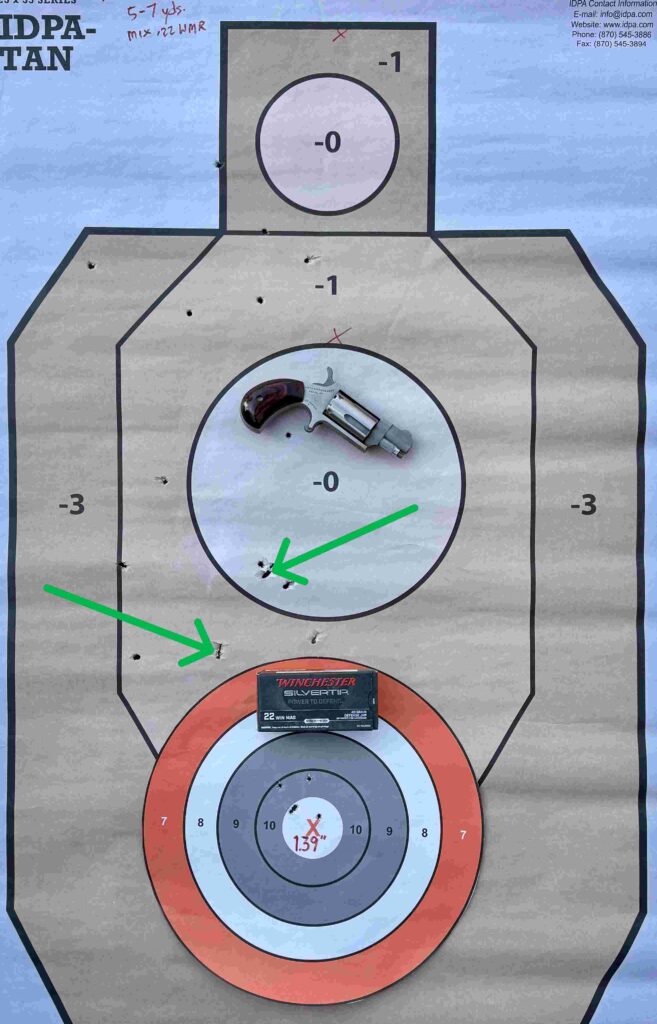
To see how the NAA-22MS mini-revolver would do in rapid fire, I sent a 23×35 Series IDPA silhouette target down to the 5-yard line. I loaded the cylinder with a mix of .22 Magnum ammo, then from a low ready, I brought the mini-revolver to bear, and fired. I cocked the hammer, got a flash sight picture, and pulled the trigger as rapidly as I could. Three shots center- mass and two head shots. I also did this at 7 yards and then back to 5 yards, for a total of 15 shots. I tried to aim high, being aware that the gun was shooting low. That didn’t work too well on the head shots; I only had 2 of 5 marginal impacts. The other three hit in the right shoulder area. The center-mass shots scored six in the -1 Zone and 4 in the -0 Zone. They all impacted left of center.
The Wrap Up
On the plus side, the NAA-22MS revolver was more accurate than I’d expected with slow, deliberate shooting. In rapid fire, it tended to shoot not only low but left, which could’ve been partly my fault. The little rosewood grips don’t give you much to hang on to, and the back of the cylinder sometimes bites your thumb. I had misfires with all but the Winchester .22 Magnum cartridges. The worst offender was the CCI ammo. Funny though – I only had these misfires when shooting slowly during the accuracy test. When shooting rapid-fire, no misfires at all. Go figure. This is a “Belly Gun” for up close and personal engagements; you don’t get much in the way of foot pounds of energy, with these small bullets, so shot placement is paramount.
As for the belt buckle. It’s a great novelty and conversation piece, but not really practical even for the BUG role. In order for the gun to fit inside the insert, the hammer has to be fully forward. With the hammer in the first “click” position, it will not go in. This means that if you plan to carry the gun loaded in the buckle, the only way to do it is with an empty chamber under the hammer. Deploying the gun from the buckle requires some deliberate steps. I got to where I could do in fairly quickly, but the buckle often came off the belt and hung loose once I’d removed the gun. You’ll also need a shorter belt as the buckle adds 5-1/2.” I had to add a hole to my shortest length belt. I also found that it barely fit between the front belt loops on my jeans. It’s kinda like one of those WWA champion belt buckles; looks great, but isn’t very comfortable to wear. And that’s the way it is. For more information, go to www.northamericanarms.com.
NAA-22MS Gun Only Specifications
MECHANISM: Single action revolver
CALIBER: .22 WMR (Magnum)
CAPACITY: 5 cartridges
BARREL: 1.13”
OA LENGTH: 4.63”
EMPTY WEIGHT: 6.2 oz.
SIGHTS: Fixed rear notch and half-moon front
FINISH: Brushed stainless-steel
STOCKS: Two-piece rosewood
MSRP: $347.00
NAA Sentinel .22 Magnum Performance
|
Cartridge |
Ave. Velocity |
Best Group |
Average Group |
Foot Pounds Muzzle Energy |
|
CCI Uppercut 40 gr. Copper-Plated HP |
957 FPS |
1.94” |
2.02” |
81.3 FPE |
|
Hornady Critical Defense 45gr. FTX-HP |
909 FPS |
1.82” |
2.44” |
82.5 FPE |
|
Speer Gold Dot Short Barrel Personal Protection 40 gr. GDHP |
908 FPS |
2.48” |
2.56” |
73.2 FPE |
|
Winchester Silvertip 40 gr. Semi-JHP |
1027 FPS |
1.39” |
1.63” |
93.7 FPE |
NOTE: Bullet weight measured in grains, velocity in feet per second 15” from the muzzle by an Garmin Xero C1 Pro chronograph, and accuracy in inches for three 5-shot groups at 21 feet.
To locate a dealer near you visit www.lipseys.com/dealerfinder